
Budgeting a Shed-Scale Mine Around the Next Difficulty Estimate
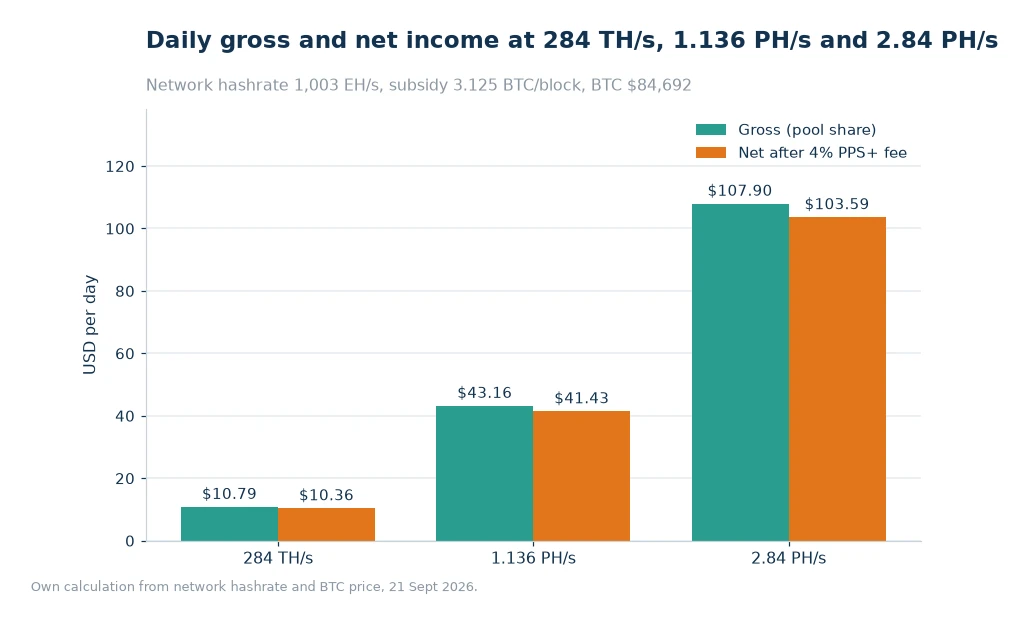
A 284 TH/s machine earns about 0.00012742 BTC a day at the current reading, $10.79 gross and $10.36 net at $84,692. The next difficulty adjustment was estimated at −2.12% when the chain data was pulled, which would lift that daily figure by roughly two percent. A shed-scale operation should plan for the estimate to be right, wrong, and wrong in the other direction, all in the same spreadsheet row.
Key takeaways
- The next adjustment was estimated at −2.12%, which would raise output per terahash by about 2.2% if it lands.
- At 284 TH/s the net credit is $10.36 a day; a 3% rise in difficulty would trim it to roughly $10.06.
- Rent, insurance and the connection fee do not move with difficulty, so a small revenue change is a larger margin change.
- Build the budget on the pessimistic row and treat the estimate as upside.
The estimate moves before the reward does
Difficulty estimates appear days before an adjustment takes effect, and they are revised as blocks arrive. That gives an operator something unusual in mining: a short forward view. It is not a promise, and it is not a reason to buy hardware, but it is enough to decide whether to fix a power contract this week or next.
The mistake is to treat the estimate as the plan. An estimate of −2.12% means the network expects to find blocks slightly faster than the protocol's target and will make the puzzle easier to compensate. If the last hours before the adjustment bring a burst of hashrate, the number can flip sign. Build the budget so that both outcomes are survivable.
Why a 2% forecast is worth modelling
Two percent sounds like noise, and for a large farm it is. For a shed running one or two machines, it is the difference between a comfortable month and a tight one, because the fixed costs are large relative to the revenue. Rent, insurance, the meter connection and the loan on the building are all priced in dollars, not in coins.
That is the leverage a small operation lives with. A 2% move in revenue against fixed costs that are 40% of revenue produces a 5% move in margin. Modelling the small number is how the operator discovers the leverage before a bank statement does, and the ViaBTC Bitcoin Mining account page is where the daily credits that feed the model actually appear.
What 284 TH/s looks like in three scenarios
The table holds the hashrate and the coin price steady and varies only the network's difficulty. That isolates the effect of the adjustment, which is the point of the exercise. Everything else is a separate sensitivity.
| Difficulty outcome | Net BTC per day | Net USD per day | Net USD per 30 days |
|---|---|---|---|
| −2.12% as estimated | 0.00012497 | $10.58 | $317.52 |
| Unchanged | 0.00012232 | $10.36 | $310.80 |
| +3% instead | 0.00011876 | $10.06 | $301.74 |
The spread between the best and worst row is $15.78 over a month. That will not change anyone's life, but it is roughly the cost of a spare fan and a filter set, which is exactly the sort of purchase a shed operator delays when the month looks tight. Knowing the spread in advance turns a vague worry into a decided line item.
The shed's fixed costs do not adjust
Every cost that is not power behaves like a rent: constant in dollars, falling as a share of revenue only when revenue rises. A shed with a $120 monthly lease and a $40 insurance premium carries $160 before a single kilowatt-hour is drawn. At $310 a month of net credit, that is more than half the margin gone.
This is why the pessimistic row is the one to budget on. If the numbers only work when difficulty falls, the operation is relying on the network's behaviour rather than on its own. The correct response to a fragile margin is not a better forecast; it is a smaller fixed cost or a higher hashrate at the same fixed cost.
Reading the adjustment clock without guessing
Difficulty adjusts every 2,016 blocks, roughly two weeks at the protocol's ten-minute target. The estimate is recalculated continuously from the average block time in the current window, which means it converges toward the truth as the window closes. Early in a window the number is a rumour; late in it, it is nearly a measurement.
An operator can use that shape. Early estimates are for awareness, not for decisions. The last day of a window is when the number is solid enough to price a contract or schedule maintenance. Checking once a week is enough for a shed; checking every hour produces anxiety without information. Write the number down each time you look, because the revision history is more instructive than any single reading and costs nothing to keep.
When the estimate is wrong in your favour
Occasionally the estimate points one way and the adjustment lands the other. The temptation is to treat the windfall as a permanent improvement and spend it. It is not permanent, and the next window will pull the number back toward the protocol's target. Bank the difference or spend it on maintenance, not on a new machine that the base case cannot support. A spare board bought with a good month is a gift to the version of you who loses one in a bad month.
There is a second asymmetry worth noting. A difficulty fall raises output per terahash, but it also tends to happen when the coin price is weak, because that is when marginal miners switch off. The two effects often arrive together and partly cancel. Planning for one without the other produces a forecast that is right in isolation and wrong in practice.
Worked example: three rows, one formula
Begin with the network's daily output, then apply the difficulty change as a divisor.
- 450 BTC ÷ 1,003,000,000 TH/s = 0.00000044865 BTC per TH/s a day.
- 284 × 0.00000044865 = 0.00012742 BTC, or $10.79 at $84,692.
- Net after the 4% block-reward charge: 0.00012742 × 0.96 = 0.00012232 BTC, or $10.36.
- If difficulty falls 2.12%: 0.00012232 ÷ 0.9788 = 0.00012497 BTC, or $10.58.
- If difficulty rises 3%: 0.00012232 ÷ 1.03 = 0.00011876 BTC, or $10.06.
- Thirty-day spread: $317.52 − $301.74 = $15.78.
Frequently asked questions
How much does a 2.12% difficulty fall add at 284 TH/s?
About $0.22 a day, taking the net credit from $10.36 to $10.58, because output per terahash rises by roughly 2.2% when difficulty falls by that amount.
Should I wait for the adjustment before buying hardware?
No. A two percent move is smaller than the spread between hardware prices and is revised before it takes effect, so it is a budgeting input rather than a purchase signal.
Why budget on the pessimistic row?
Because rent, insurance and connection fees stay fixed in dollars while the credit moves with difficulty, so a 3% revenue cut at 284 TH/s lands on the margin almost in full rather than being spread across the cost base.
Put the estimate in the spreadsheet, not the decision
Three rows, one formula, five minutes a month: that is the whole discipline. If the pessimistic row still covers the shed's fixed costs and leaves something for maintenance, the operation is robust. If it does not, the answer is a cheaper building or more hashrate, and the Profit Calculator will price the second option at today's difficulty. The pool state page is where the current window's block times are visible, which is the closest thing to the number the next adjustment will use.
Sources: ViaBTC calculator and pool state pages, with chain data read 21 Sept 2026 — network hashrate 1,003 EH/s, difficulty 132.76 T, 3.125 BTC per block, 144 blocks a day, BTC $84,692, next difficulty estimate −2.12%. Fixed costs in the text are illustrative. Published 24 Oct 2026[1].