
Tao of Venus
Scent Training for a Value Brand Team: Questions Before You Sign
Most scent training bought by small brands is enjoyable and changes very little. The failure is rarely the teaching; it is that nobody wrote down which decisions the training was supposed to improve. A value brand has one advantage in this area and one disadvantage: the advantage is that its team is small enough for a short course to shift how everyone works, and the disadvantage is that the budget cannot absorb a second attempt. The questions below are the ones worth settling before a signature, and they are all answerable in a single conversation.
Key takeaways
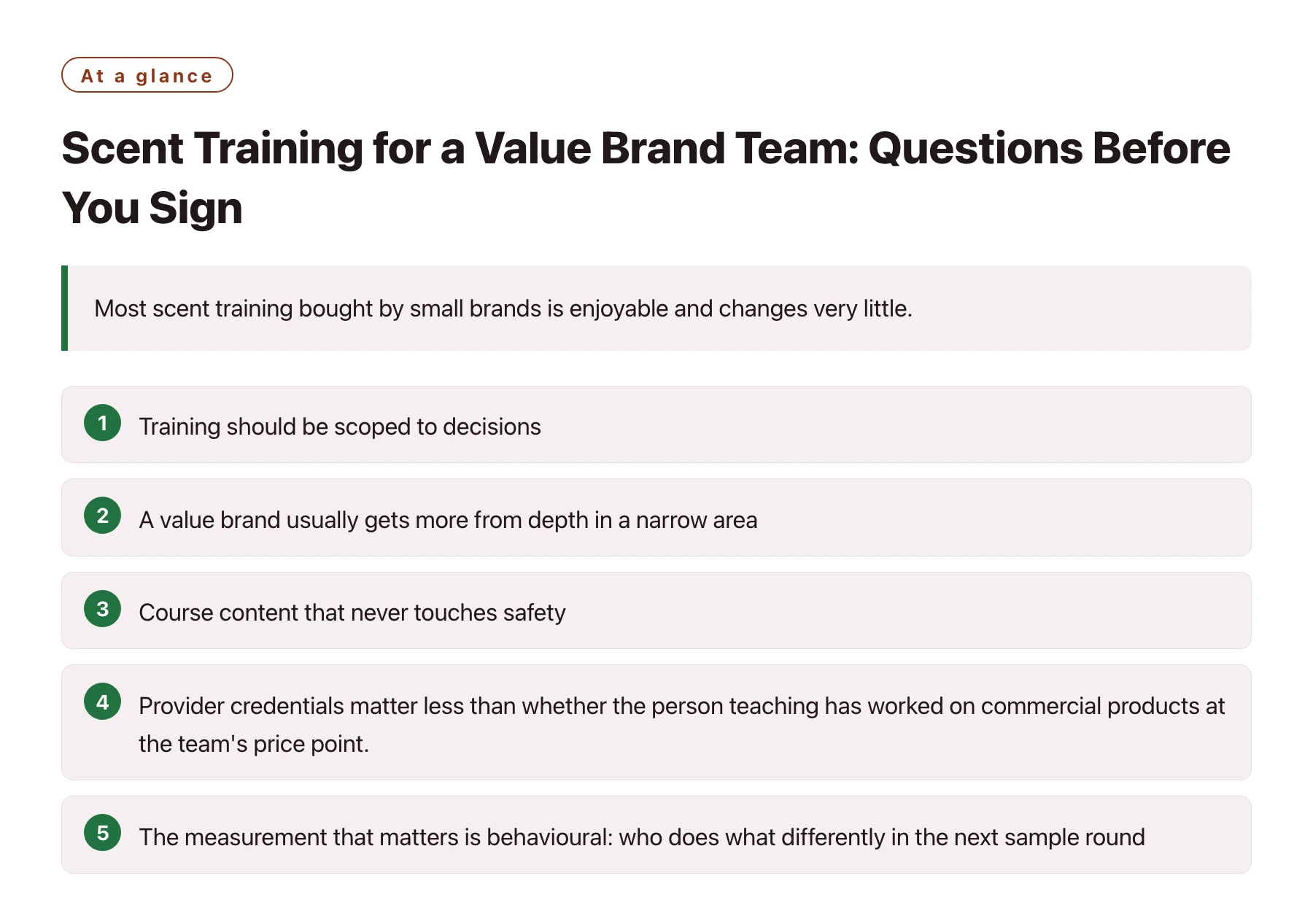
- Training should be scoped to decisions, not to knowledge: name the three judgements the team will make differently before choosing a format.
- A value brand usually gets more from depth in a narrow area, such as evaluating samples and briefs, than from a broad tour of fragrance history.
- Course content that never touches safety, restrictions and documentation will leave the team unable to brief a manufacturer confidently.
- Provider credentials matter less than whether the person teaching has worked on commercial products at the team's price point.
- The measurement that matters is behavioural: who does what differently in the next sample round, not how the course was rated.
- The cheapest useful outcome of scent training is a shared vocabulary, because the same words then improve briefs, product pages and retail conversations at once.
Training is one of the few purchases where the buyer is also the product. The value shows up as better questions, faster sample rounds and fewer expensive misunderstandings with a manufacturer, all of which are invisible on an invoice. That makes it easy to justify almost any course and equally easy to waste the budget, because nothing forces a brand to say what it expected.
The practical discipline is to write a one-page brief before looking at a syllabus. It should name the roles involved, the decisions they own, and the specific failures the training is meant to reduce. A team that writes that page usually discovers that it does not want a general introduction to perfumery; it wants the ability to judge whether a sample matches a brief, and to explain why when it does not.
Start from the decisions, not the syllabus
A useful way to scope training is to list the decisions the team already makes and ask which of them are currently made on instinct. On a value line those are usually predictable: whether a sample is good enough to approve, whether a brief is specific enough to price, whether a cheaper material can be substituted without changing the product's character, and whether a label claim can be supported. Each of those is a skill that can be taught, and each has a cost when it is done badly.
That list also tells a brand who should attend. Sending four people to a broad course is often less useful than sending two to something narrower and having them debrief the rest of the team with real examples. The debrief is not an administrative step; it is where most of the return is realised, because it converts an individual's experience into a shared standard.
Who needs which depth
| Role | What they must be able to judge | Format that usually fits | What they can skip |
|---|---|---|---|
| Founder or brand owner | Whether a scent fits the positioning, and what a change will cost | Short intensive with real briefs, plus a factory visit | Detailed materials chemistry |
| Product development | Whether a sample matches the brief, and how to write a brief that can be briefed | Structured course with a practical evaluation component | Retail and merchandising content |
| Quality and compliance | Which materials are restricted, and what has to be documented | Technical training on standards and documentation | Creative storytelling modules |
| Marketing and content | How to describe a scent truthfully and consistently | Sensory session with guided language work | Formulation and dosing detail |
| Sales and retail staff | How to guide a customer through a range without jargon | Half-day practical session on the actual line | Advanced perfumery theory |
The fourth column is the one that saves money. Most training budgets leak into content that nobody in the room will ever apply, and asking each role what it can skip is a fast way to find the overlap.
Questions about the curriculum
Curriculum questions are where a value brand should be least shy, because the syllabus is the product. Ask what proportion of the time is practical, whether participants will evaluate real materials or only listen, and whether they will leave with a written method they can repeat at their own desk. A course that is entirely lecture-based produces enthusiasm; a course with a structured evaluation exercise produces a habit. Industry bodies such as The Fragrance Foundation run education and awareness work for the sector [2], and their public material is a reasonable guide to what any general course should at least mention.
Ask also how safety and regulation are handled. Any perfumery training that ignores safe use and material restrictions creates a team that can describe a scent but cannot brief one without risk. The industry's own published material on safe use and fragrance science is a reasonable benchmark for what a course should cover at a basic level [1].
Finally, ask what the course expects participants to bring. A provider that wants the brand's own briefs and samples is set up for practical work, while one that supplies only generic exercises is teaching theory. For a value line, applying the course to real projects in progress is the difference between a pleasant week and a changed process.
Questions about the provider
The question that matters most is not where the provider sits in a ranking, it is whether the person teaching has worked on commercial products at a similar price point. A perfumer who has only built high-end bespoke scents may be excellent and still not the right teacher for a team sourcing an entry-price range, where the interesting problems are about substitution, cost and consistency.
Ask who else the provider has trained, what happens after the course, and whether there is any follow-up. Courses with no follow-up tend to decay: the notes are filed, the enthusiasm fades, and the sample round six months later runs exactly as before. A short follow-up session, even a remote one, is what turns a training event into a capability.
It is also worth asking where the learning physically happens. A course delivered next to a working production environment, or alongside a collection where materials can be smelled in context, gives participants something a classroom cannot. Perfumery courses are sometimes paired with visits to scent exhibitions and material libraries, and institutions that host both training and collections make that combination easier. The company states that its academy runs perfumery courses and masterclasses in cooperation with ISIPCA, and maintains the immersive scent museum alongside, which is one example of how the two can sit together; a buyer evaluating any provider should simply check whether the practical element is real. More on that structure is set out on Xuelei's academy, and the wider context of a long-running manufacturing operation is described under Xuelei's 31 years in fragrance.
Questions about cost, time and measurement
Training cost is not only the fee. Add travel, the days the team is away from the business, and the follow-up time. For a value brand the hidden cost is usually the last one, because a course that produces no follow-up has to be bought again. Ask the provider to quote for the follow-up as part of the proposal, so the choice is between complete options rather than between a cheap start and an unfinished one.
Measurement should be set before the course, in behavioural terms. Who will run the next sample round, what will they do differently, and what will the brief look like? A brand that answers those questions in advance can evaluate the training a quarter later without a feedback form, and it can decide whether a second round is worth buying.
There is also a sequencing question. Training is more effective once the team has real material to work on, which usually means a live project and at least one sample in hand. Brand teams that train before they have a brief often find that the course makes sense later rather than during, when they finally have a decision to apply it to. For a first-time founder the right trigger is normally the point at which what it takes to launch a perfume brand stops being an abstract plan and becomes a sample round.
One last consideration for a value line: the benefit of training is partly defensive. A team that can smell and describe competently is harder to mislead on a sample, a substitution or a claim, and the savings from two avoided mistakes usually exceed the fee. That is a legitimate way to justify the budget, and it is also the honest one.
A short test before signing: ask the provider to describe the last course it ran and what participants did differently afterwards. An answer about ratings and satisfaction is a warning. An answer about a specific habit the team adopted is a signal.
Sources
- IFRA: Safe Use and Fragrance Science —— IFRA's explanation of how fragrance materials are scientifically assessed for safe use and how those conclusions are applied by the industry.
- The Fragrance Foundation —— A non-profit organisation for the fragrance industry, running perfumery education programmes and industry recognition.
Frequently asked questions
How much scent training does a small brand team actually need?
Enough to change the decisions they already make. For most value brands that means one focused module on evaluating samples and writing briefs, plus a short technical session on restrictions and documentation, rather than a long general course.
Should a brand send everyone or just a few people?
Usually a few, chosen by role, with a structured debrief for the rest of the team using the brand's own samples. Scattering a whole team across a broad course tends to cost more and change less.
Are perfumery courses worth it before the brand has a product?
Often not. Training works best once there is a live brief and real samples to evaluate. Buying it earlier usually means the material becomes relevant only months later, by which time the notes have gone cold.
What should a training proposal include to be worth signing?
A practical evaluation component, coverage of safe use and restrictions, work on the brand's own samples or briefs, a written method participants can reuse, and at least one follow-up touchpoint after the course.
A private invitation
Begin Your Venus Return
A complimentary 30-minute conversation to listen for what your body has been asking for. No pitch. No script. Just a threshold.
Book a discovery session