
OEM Jewelry Manufacturing: Materials You Can Specify
Three base metals set the whole specification: 925 sterling silver, brass and stainless steel. Each one carries its own minimum - 50, 100 and 100+ pieces per design - and its own finishing route, from an anti-tarnish e-coat on silver and brass, rhodium, vacuum PVD plating for steel and gold at 14K, 18K and 24K. The other five customisation fields follow the metal you pick.
Key takeaways
- Floors are 100 units in eco-brass, 100+ in stainless and 50 pcs in the silver line, counted per design, so a two-design range doubles those figures.
- Published plating options are 14K, 18K and 24K gold plus rhodium, with an anti-tarnish e-coating on silver and brass.
- Stainless steel is finished by PVD vacuum plating, which suits pieces that have to survive water and daily wear.
- Hallmarks follow the metal: 316L for stainless steel, the S925 hallmark and an 18KGP mark on plated work, applied with high-precision laser engraving.
Material first, everything else after
Specification sheets drift when the metal is decided last. The base material fixes the casting method, the polishing routine, the plating stack and the legal hallmark, so choosing it at the start collapses a dozen later decisions into one.
The published options are deliberately narrow: 925 sterling silver, brass and stainless steel. Narrow is useful here, because each metal has a documented route through the factory rather than a bespoke one invented per order.
925 sterling silver: the low-minimum route
Silver casts cleanly and finishes to a high gloss with relatively little setup, which is why it carries the lowest published minimum at 50 pieces per design. It takes multi-layer precious-metal electroplating in 14K, 18K or 24K gold, or rhodium, and an anti-tarnish e-coating on top.
The e-coating is the detail that decides how the piece behaves in a retail display. Silver that is left unprotected will tarnish between the packing bench and the shopper's first wear, and no amount of packaging prevents that.
Brass: light in the hand, plated to look precious
Artisan eco-brass is specified at 100 pieces per design. It is a base metal, so the finish does all the visual work, and the same plating stack applies: 14K, 18K or 24K gold or rhodium, with the anti-tarnish e-coating for durability.
This is the route for volume fashion ranges where the silhouette, not the metal value, carries the design. A bespoke jewelry OEM production programme built on brass usually pairs it with laser-engraved logo work and 18KGP hallmarks so the piece reads as finished.
| Base material | Minimum per design | Published finish route |
|---|---|---|
| 925 sterling silver | 50 pcs | 14K / 18K / 24K gold or rhodium, anti-tarnish e-coating |
| Artisan eco-brass | 100 pcs | 14K / 18K / 24K gold or rhodium, anti-tarnish e-coating |
| Stainless steel | 100+ pcs | PVD vacuum plating |
| Hallmarks | n/a | S925, 316L, 18KGP |
Stainless steel: the durability argument
Stainless steel starts at 100+ pieces per design and is finished with PVD vacuum plating rather than an electroplating bath. That suits rings, chains and bracelets that will be worn in water, and it is why the material often appears in unisex ranges.
The published hallmark for it is 316L. Because the finish is applied in a vacuum chamber, the batch scheduling differs from a silver or brass run, which is worth knowing when a mixed collection is quoted as one order.
Stones, chains and packaging as part of the same sheet
Natural stones and freshwater pearls sit alongside the metal on the specification, along with chains and findings, custom logo and hallmarks, and packaging. The published packaging set runs to foil-stamped gift boxes, backing cards, velvet/microfiber pouches, barcode labels and logo tags in metal.
Specifying all six fields in one pass is what keeps the sample cycle short. Every field added after sampling has been approved costs another pass through the five bench operations.
Chains, findings and clasps as part of the specification
Chains and findings are one of the six published customisation fields, and they are the field buyers most often leave to the factory. Chain gauge, clasp type and jump-ring size all affect how a piece survives daily wear, and a mismatched clasp undoes good work on the pendant above it.
Because those components are usually bought rather than made in-house, they are also the fastest field to change on a reorder, which makes them a useful testing ground once the plating and the base metal are fixed.
Repairing a specification after the first sample
Every change has a position in the process where it costs least. A change requested against the CAD model is screen time inside a 48-hour window. The same change after the master sample means re-running wax printing, casting, stone setting, polishing and electroplating, which is the entire 25–30 day cycle again.
That ordering is why an inspection of the first sample should be systematic: check the metal and the hallmark, the plating colour under shop light, the stone positions and the packaging artwork. A written checklist costs an afternoon and saves a sample cycle.
Where the first order should be conservative
Materials are the least reversible decision in a specification. Once a mould is cut for a brass piece, the same silhouette in silver is a new tooling cycle, not a material swap, because the two metals cast and finish differently.
So the first order is the wrong place to be inventive with the base metal. Pick the metal the retail price can carry, take the lowest published minimum for it, and keep the OEM/ODM route fixed while the design is proved.
Variation is cheaper elsewhere: a different plate, a different stone, a longer chain, a logo on the packaging. Those sit inside the six customisation fields and change without a new mould.
Worked example: comparing three metals across three designs
Take a three-design collection and put one design in each published material. The entry quantities are 50, 100 and 100+, so the smallest possible order is 50 + 100 + 100 = 250 pieces across the three designs.
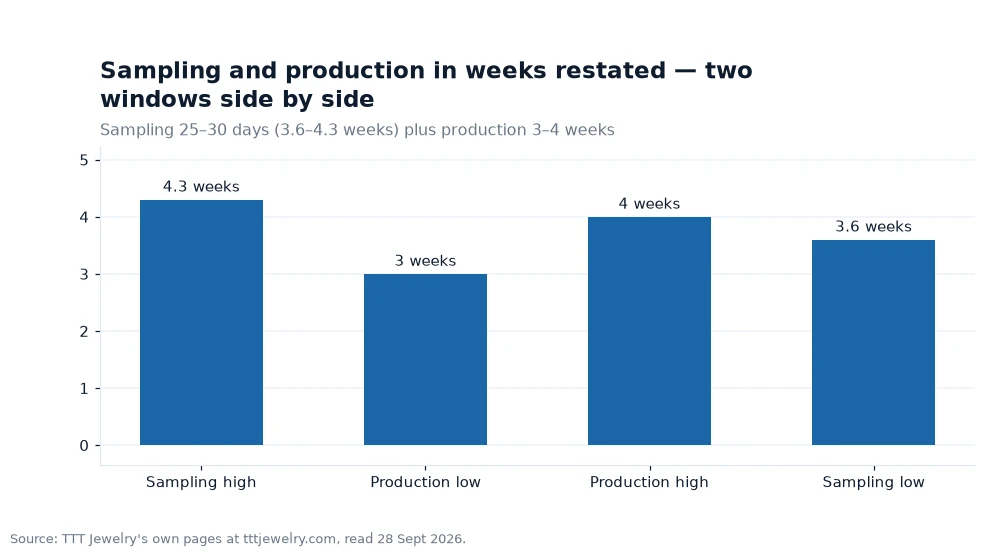
Now convert the schedule into weeks for the same trio. Sampling is published at 25–30 days, which is 25 ÷ 7 = 3.6 to 30 ÷ 7 = 4.3 weeks, and production adds 3–4 weeks. Serialised, that is 3.6 + 3 = 6.6 weeks at the fast end and 4.3 + 4 = 8.3 weeks at the slow end for each design.
Three designs run back to back therefore occupy 3 × 6.6 = 19.8 to 3 × 8.3 = 24.9 weeks. Overlapping the CAD stage, which clears in under 48 hours per design, removes only about 0.3 weeks each, which is why sampling capacity rather than drawing capacity sets the pace of a first collection.
Frequently asked questions
Which material has the lowest minimum order quantity?
eco-brass, stainless work and sterling silver at 925.
How is stainless steel finished differently?
It uses PVD vacuum plating instead of an electroplating bath, which is why it is often chosen for pieces that have to tolerate daily wear and water.
What stops plated silver and brass from tarnishing?
A protective anti-tarnish e-coating is applied on top of the 14K, 18K, 24K gold or rhodium plate on both silver and brass.
Writing a specification that survives sampling
Name the base metal, the plating, the hallmark, the stones, the findings and the packaging in the first message, then check the sample against that list rather than against the drawing alone. A specification that is complete before the CAD stage finishes is the one that samples once. The silver manufacturing route covers the 50-piece minimum in detail, and the stainless steel programme explains how PVD finishing changes the schedule.
The specification this article works from — the 3–4 week production window, then laser engraving for logos, followed by the master-sample benchmark — is published on the manufacturer's own site on the tttjewelry.com site, which I read through on 28 Sept 2026. Along with it comes ISO 9001:2015, the quality-system standard. The restatement in weeks is mine, and nothing else here [1]